
Tron (TRX)
Current USDT transfer fee on the Tron network
Estimated cost per TRC-20 USDT transfer
 Updated Sep 18, 2026 at 09:00 UTC
Quick Facts
| Native Token | TRX |
| Consensus | DPoS |
| Block Time | ~3 seconds |
| USDT Standard | TRC-20 |
About Tron
Tron was founded by Justin Sun in 2017. The project launched as an ERC-20 token on Ethereum before migrating to its own mainnet in June 2018. Originally focused on decentralized content sharing and entertainment, Tron evolved into one of the most active DeFi platforms in the industry. Its combination of low fees and fast confirmation times made it the dominant network for USDT transfers — today Tron carries more Tether volume than any other blockchain.
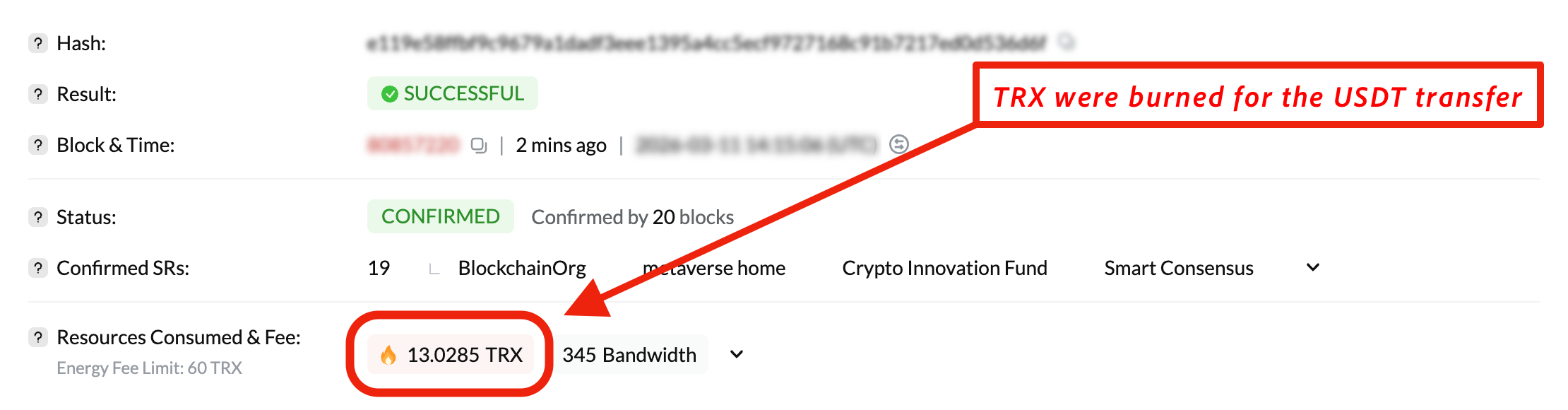
Tron's fee model differs from Ethereum's simple gas system. Instead, it uses two resources: energy (consumed by smart-contract execution) and bandwidth (consumed by transaction data size). Users can stake TRX to earn these resources for free, or the network burns TRX as a fallback payment when resources are insufficient. A standard USDT transfer to an existing wallet costs roughly 6.4 TRX, while a transfer to an empty (unactivated) wallet costs about 13.4 TRX due to the additional account-creation overhead.
In August 2025, Tron governance passed Proposal #104, cutting the energy unit price from 210 sun to 100 sun. This change roughly halved the cost of smart-contract transactions, including TRC-20 USDT transfers. The proposal made Tron even more competitive for everyday stablecoin payments.
Despite its centralization concerns — only 27 Super Representatives produce blocks — Tron's pragmatic approach to low-cost transactions has secured its place as a critical piece of global stablecoin infrastructure, particularly in emerging markets where transfer fees matter most.
#How TRC-20 USDT Transfer Fees Are Calculated
Unlike Ethereum, where every operation is priced in a single "gas" unit, Tron splits transaction costs into two separate resources: energy and bandwidth. Energy is consumed whenever the network executes smart-contract logic — and since USDT is a TRC-20 token, every transfer triggers that logic. Bandwidth, on the other hand, covers the raw byte size of the transaction data itself. If your wallet doesn't have enough of either resource, the Tron network automatically burns your TRX to pay for the shortfall.
Transfer to an Activated vs. Empty Wallet
The cost of a USDT transfer depends heavily on whether the recipient wallet has been used before:
- Activated wallet (already holds any TRC-20 token): approximately 6.4 TRX. Even a tiny balance — say 0.1 USDT — is enough for the wallet to be considered activated.
- Empty / unactivated wallet: approximately 13.4 TRX. The extra cost comes from account-creation overhead that the network charges when it registers a brand-new address on-chain.
Practical Ways to Lower Your Tron Fees
- Pre-fund the recipient wallet. Sending even a dust amount of USDT (or any TRC-20 token) to the destination address beforehand activates the account and cuts the transfer fee nearly in half — from 13.4 TRX down to 6.4 TRX.
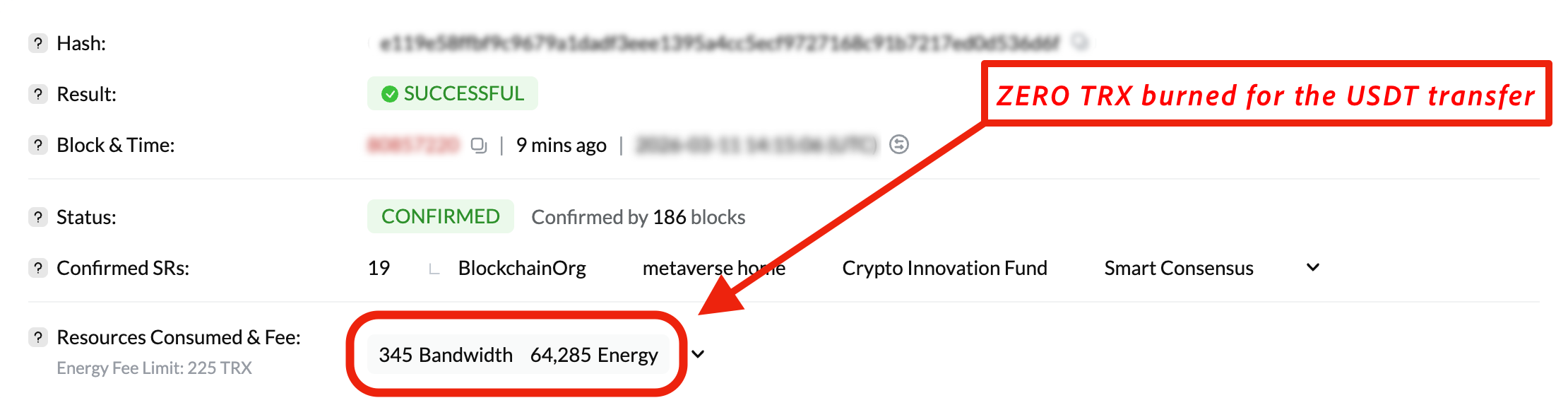
- Stake TRX for free energy. Through Tron's Stake 2.0 system you can freeze TRX to generate energy. If you transfer USDT regularly, staking enough TRX can bring your per-transfer fee to virtually zero — and you earn roughly 4% APY on the staked amount as a bonus.
- Rent energy from third-party providers. Transactions can be executed using delegated energy instead of burning TRX. This can significantly reduce the cost of transfers for users who do not want to stake TRX.
- Send native TRX when possible. TRX-to-TRX transfers don't consume energy at all — they only use bandwidth, and every Tron wallet receives a free daily bandwidth allowance. Whenever the situation allows, paying in TRX instead of USDT is essentially free.
- Don't split transfers unnecessarily. Sending 1 USDT and sending 10,000 USDT costs exactly the same fee. Consolidate your transfers into fewer transactions to avoid paying the fixed cost multiple times.