
Tron Slashes Fees by 50% After Proposal #104
How a single governance vote in August 2025 halved the cost of every smart-contract transaction on Tron.
August 29, 2025
Then
- Activated wallet: 27.25 TRX
- Unactivated wallet: 13.4 TRX
- Energy unit price: 210 sun
Now -50%
- Activated wallet: 13.4 TRX
- Unactivated wallet: 6.4 TRX
- Energy unit price: 100 sun
What Happened
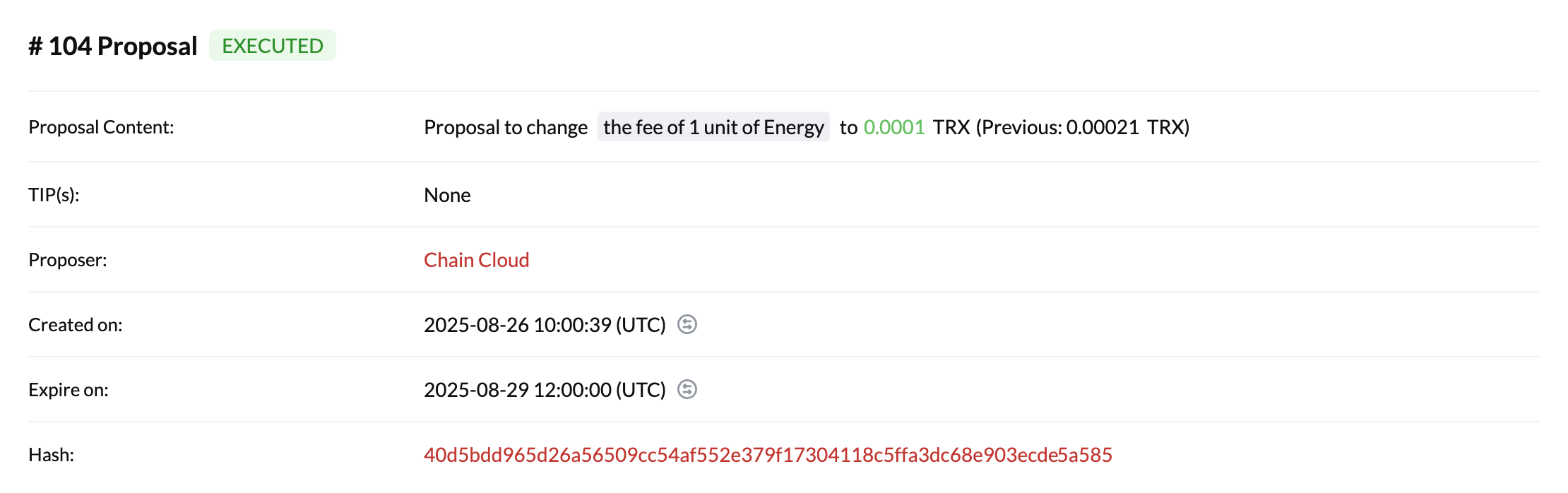
On August 29, 2025, Tron governance passed Proposal #104 — a network-wide parameter update that lowered the energy price from 210 sun to 100 sun. Since energy is the main resource used by smart-contract transactions (such as TRC-20 token transfers), this move effectively cut Tron transaction fees in half.
The proposal was submitted on-chain by the Super Representative Chain Cloud on August 26, 2025, and the voting window ran until August 29. Out of 27 Super Representatives, 25 voted in favor and only two abstained — an overwhelming mandate. The change took effect immediately upon approval. The full voting record is available on TronScan.
Why This Change Was Needed
TRON has built a reputation for fast and inexpensive transactions. But as the price of TRX has roughly doubled since 2024, using the network has become noticeably more expensive.
Fee Changes Over Time
| Period | Avg. TRX Price | TRC20 USDT Transfer Fees |
|---|---|---|
| 2024-Q1 | $0.12 | $1.64 |
| 2024-Q2 | $0.12 | $1.58 |
| 2024-Q3 | $0.14 | $1.91 |
| 2024-Q4 | $0.21 | $2.80 |
| 2025-Q1 | $0.24 | $3.22 |
| 2025-Q2 | $0.26 | $3.52 |
| 2025-Q3 | $0.32 | $4.28 |
The Technical Change
Tron uses a unit called "sun" to denominate its smallest resource prices (1 TRX = 1,000,000 sun). The energy unit price determines how much TRX is burned per unit of energy when a user does not have enough staked energy to cover a transaction. Before Proposal #104, each energy unit cost 210 sun (0.000210 TRX). After the change, it dropped to 100 sun (0.000100 TRX).
For context, a standard USDT transfer to an existing wallet consumes approximately 65,000 energy units. At the old rate:
- 65,000 energy × 210 sun = 13,650,000 sun = 13.65 TRX
After Proposal #104:
- 65,000 energy × 100 sun = 6,500,000 sun = 6.5 TRX
The difference is even more pronounced for transfers to new (empty) wallets, which require roughly 130,000 energy:
- Before: 130,000 × 210 sun = 27.3 TRX
- After: 130,000 × 100 sun = 13.0 TRX
Impact on USDT Transfer Costs
At a TRX price of approximately $0.16 (at the time of the proposal), the practical impact on USDT transfer fees was significant:
| Scenario | Then | Now | Savings |
|---|---|---|---|
| Transfer to existing wallet | ~13,4 TRX | ~6,4 TRX | ~52% |
| Transfer to empty wallet | ~27,25 TRX | ~13,4 TRX | ~51% |
These figures assume users are paying entirely through TRX burning (no staked energy). Users who partially cover costs through staking saw proportionally smaller but still meaningful reductions in their fallback burn costs.
Why Tron Made This Move
Justin Sun, Tron's founder, framed the decision as a strategic trade-off: accepting lower short-term revenue from transaction burns in exchange for greater long-term network adoption. Lower fees make Tron more attractive for everyday stablecoin payments, remittances, and micro-transactions — use cases where cost sensitivity is high.
On August 26, 2025, the Tron Super Representative community proposed to reduce Tron network fees by 60%. This is the largest fee reduction since the founding of the Tron network. The proposal has already passed and will take effect at 20:00 (GMT+8) this Friday!
— H.E. Justin Sun 👨🚀 🌞 (@justinsuntron) August 29, 2025
Here’s my view on…
Sun publicly described Proposal #104 as the largest fee reduction in Tron's history. He acknowledged that cutting the burn rate would dent near-term protocol revenue, but expressed confidence that a surge in transaction volume and new user onboarding would more than compensate over time. He also noted that the Super Representative community has committed to revisiting fee parameters on a quarterly basis, monitoring TRX price, network load, and ecosystem growth to keep the balance between profitability and competitiveness.
The reasoning follows a familiar pattern in the blockchain industry. Networks compete for user activity, and stablecoin transfer volume is among the most valuable forms of on-chain activity because it drives real economic utility rather than speculative trading. By reducing friction, Tron aims to widen its lead in the stablecoin transfer market. Historical precedent backs this up — Proposal #95 in 2024, which also halved energy costs, led to a measurable uptick in smart-contract deployments and overall ecosystem activity.
Tron's Position in the Stablecoin Market
Tron has established itself as a critical infrastructure layer for global stablecoin transfers. By 2025, the network hosted more than $82 billion in USDT — compared to approximately $148 billion on Ethereum. While Ethereum holds more USDT by total value, Tron processes a larger number of individual transactions, driven by its lower costs and faster confirmation times.
The network is particularly dominant in emerging markets where users prioritize low fees over decentralization properties. Regions in Southeast Asia, the Middle East, and Africa have seen significant adoption of TRC-20 USDT for peer-to-peer payments, salary disbursements, and cross-border commerce.
Proposal #104 reinforced this competitive advantage. With fees now roughly comparable to what they were before Tron's previous fee increase, the network reaffirmed its commitment to remaining the most cost-effective major chain for stablecoin operations.
Effect on Staking Economics
The fee reduction also affects the calculus for TRX staking. Since the energy unit price dropped, users who stake TRX for energy now enjoy an even greater advantage over those who burn. The amount of TRX needed to stake for one USDT transfer's worth of energy remains the same (determined by total network stake, not the energy price), but the fallback burn cost — the alternative to staking — is now half of what it was. This makes staking relatively more attractive.
For exchanges and high-volume senders who process thousands of USDT transfers daily, the savings are substantial. A service handling 10,000 transfers per day saves approximately 70,000 TRX (~$11,000) daily compared to pre-proposal costs.
Looking Ahead
Proposal #104 is a governance-level change, meaning it can be reversed or further adjusted by a future Super Representative vote. Tron's history includes previous adjustments in both directions — the energy unit price was raised to 210 sun in an earlier proposal before being reduced to 100 sun. Future changes will depend on network conditions, TRX price dynamics, and the competitive landscape among blockchains vying for stablecoin volume.